Long before the marble cathedral rose, this site held some of Christian Milan’s most important churches and baptisteries. That deep religious continuity explains why today’s archaeological area feels less like an add-on and more like the Duomo’s buried first chapter.
Duomo Milan history and legacy
Few buildings tell Milan’s story as vividly as this cathedral, built from 1386 to 1965. Its marble spires, ancient baptistery remains, and walkable terraces let you trace 6 centuries of faith, politics, and restoration in a single visit.
Duomo Milan timeline
- 335: Early Christian roots — The Baptistery of San Giovanni alle Fonti is built on the future Duomo site.
- 1386: A new cathedral begins — Milan launches an ambitious Gothic rebuild under Gian Galeazzo Visconti.
- 1387: Fabbrica established — The Veneranda Fabbrica begins supervising construction, funding, and stone supply.
- 1402: Momentum falters — Visconti’s death slows progress and starts centuries of stop-and-start building.
- 1562: A Renaissance masterpiece arrives — Marco d’Agrate carves the striking St. Bartholomew statue.
- 1774: Madonnina installed — The gilded Virgin Mary becomes Milan’s defining skyline symbol.
- 1805: Napoleon accelerates works — His coronation in Milan pushes long-delayed façade completion.
- 1943: War reaches Milan — Bombing damages parts of the surrounding center, prompting repairs.
- 1965: Final details finished — The last ornamental work closes a 6-century construction story.
Duomo Milan’s history explained
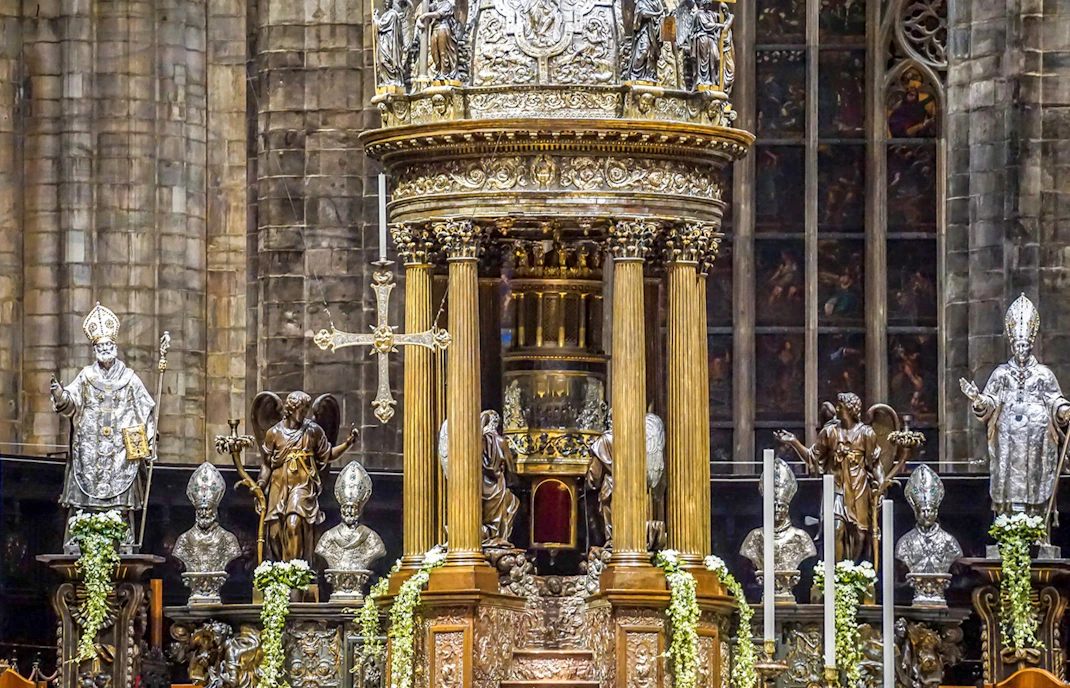
Sacred ground before the cathedral 4th century – 1386
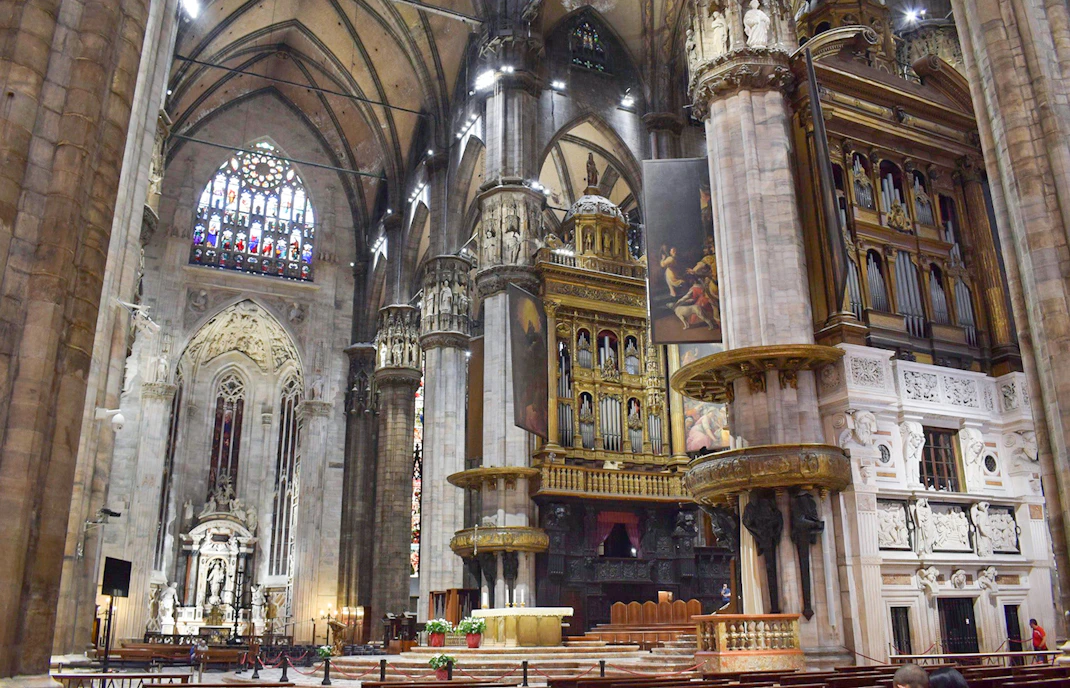
A European Gothic experiment 1386 – late 1400s
The early Duomo was unusually international. French, German, and Lombard builders worked side by side, while Candoglia marble arrived through specially arranged canals. What you see today is Milan’s Gothic identity shaped by ideas flowing across late medieval Europe.
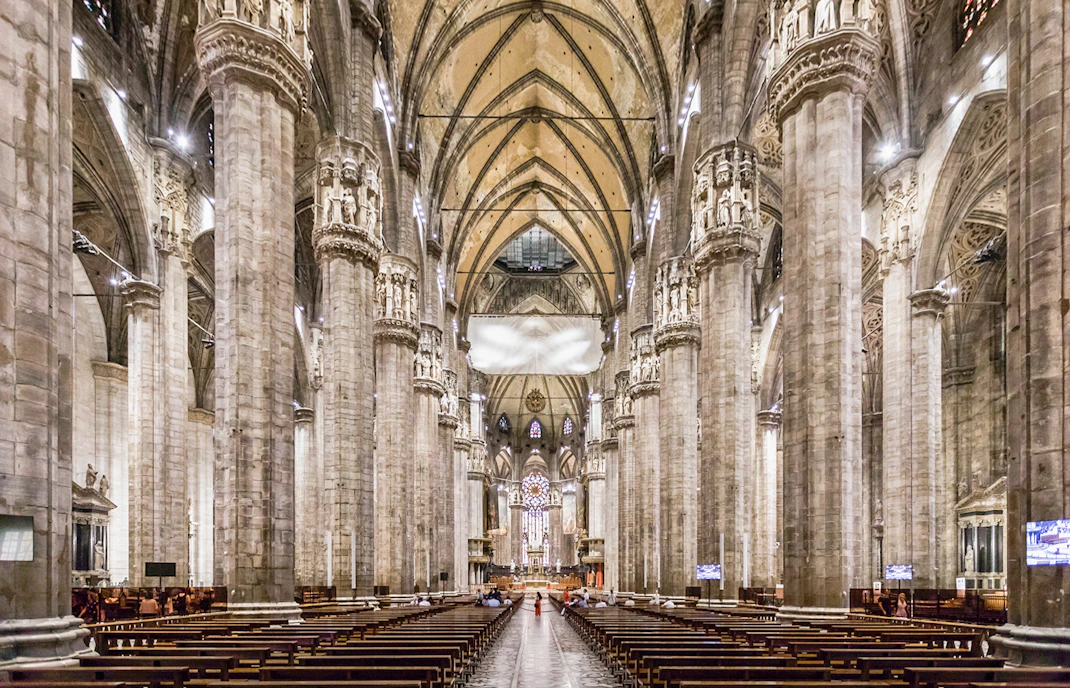
Reinvention across centuries 1500s – 1700s
The project never stood still. Renaissance tastes, Counter-Reformation priorities, new chapels, and fresh decorative programs kept reshaping the cathedral. The result is a building where medieval structure and later religious art still speak to each other inside the nave.
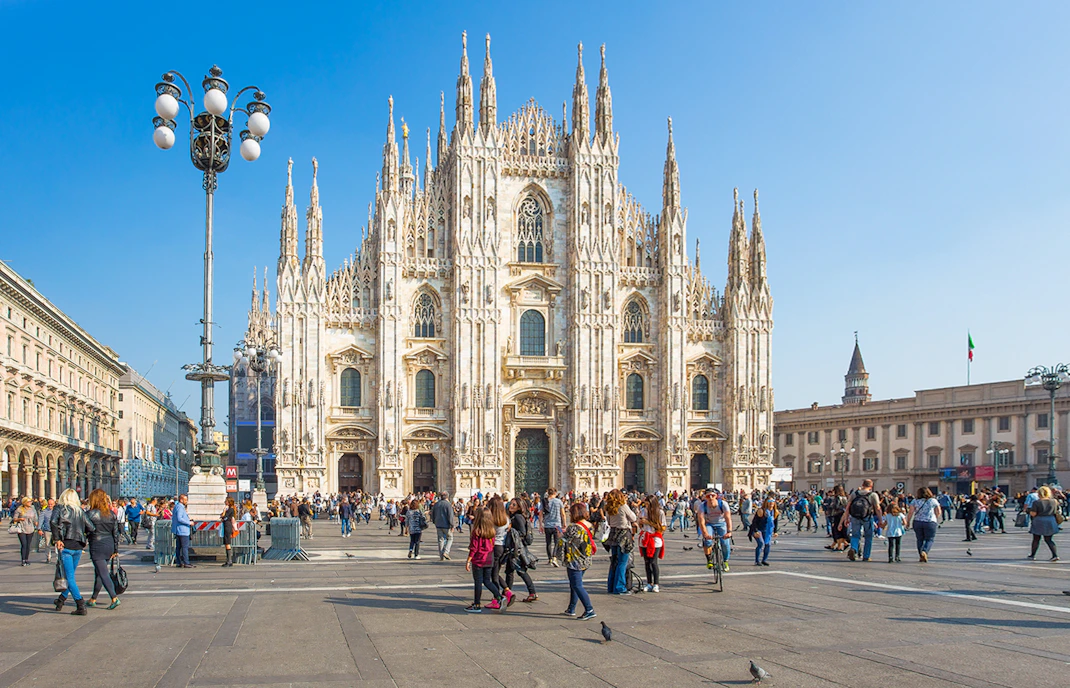
Façade, nation, and memory 1805 – 1965
Napoleon’s era gave urgency to the façade, while the 19th century turned the Duomo into a civic emblem as much as a church. After 20th-century damage and repairs, the final details completed a monument that had come to symbolize Milan itself.
Construction and architecture of Duomo Milan
Begun in 1386, the cathedral was built chiefly in Candoglia marble, a pale stone still tied to the Duomo’s identity. Its design is predominantly Gothic, with pointed arches, soaring vaults, stained glass, flying buttresses, and a roofline crowded with spires and sculpture. Because work continued for centuries, later Renaissance, Baroque, and Neo-Gothic touches also entered the project. Ongoing stone replacement and cleaning are part of why the building still feels so alive today. For more detail, continue to the Duomo Milan architecture page.
Additional information about Duomo Milan’s history
| Location | Best historical focus | Main period/story | What to look for |
| --- | --- | --- | --- |
| Cathedral interior | Religious and artistic evolution | Medieval core with later additions | Stained-glass windows, main altar, St. Bartholomew |
| Terraces | Exterior craftsmanship and symbolism | Mostly late medieval onward, finished over centuries | Spires, statues, marble carving, views toward the Madonnina |
| Duomo Museum | Context and preservation | 14th century onward | Original sculptures, models, stained glass, Madonnina replica |
| Archaeological area | Earliest Christian Milan | 4th century | Baptistery remains and the site’s pre-Duomo past |
| St. Charles Crypt | Early modern devotion | 16th–17th centuries | Saint Charles Borromeo’s memory and post-Tridentine spirituality |
Historical focus route 30–60 minutes
- Start in Piazza del Duomo (Google Maps: ‘Duomo di Milano’) and study the façade before entering.
- Inside, head first to the nave and stained glass, then pause at St. Bartholomew.
- Continue to the archaeological area to see the site’s 4th-century roots.
- If your ticket includes it, visit the St. Charles Crypt for the Counter-Reformation chapter.
- Finish on the terraces, where centuries of carving, repairs, and skyline symbolism become easiest to read.
Quick tips for history-minded visitors
- Visit before 10am for softer light on the marble and a calmer interior.
- Pair the cathedral with the Duomo Museum if you want the clearest before-and-after context.
- The broadest historical coverage comes from Milan Duomo Full Complex Skip-the-Line Tickets with Terrace Access, because it includes the Archaeological Area and St Charles Crypt.
- If you want flexibility with optional audio commentary, Milan Cathedral, Museum & Terraces Tickets are a strong self-guided choice.
- If you prefer expert storytelling on site, Milan Cathedral and Terraces Skip-the-Line Guided Tour is the most direct way to connect the roof, statues, and interior history.
Duomo Milan today – why it matters
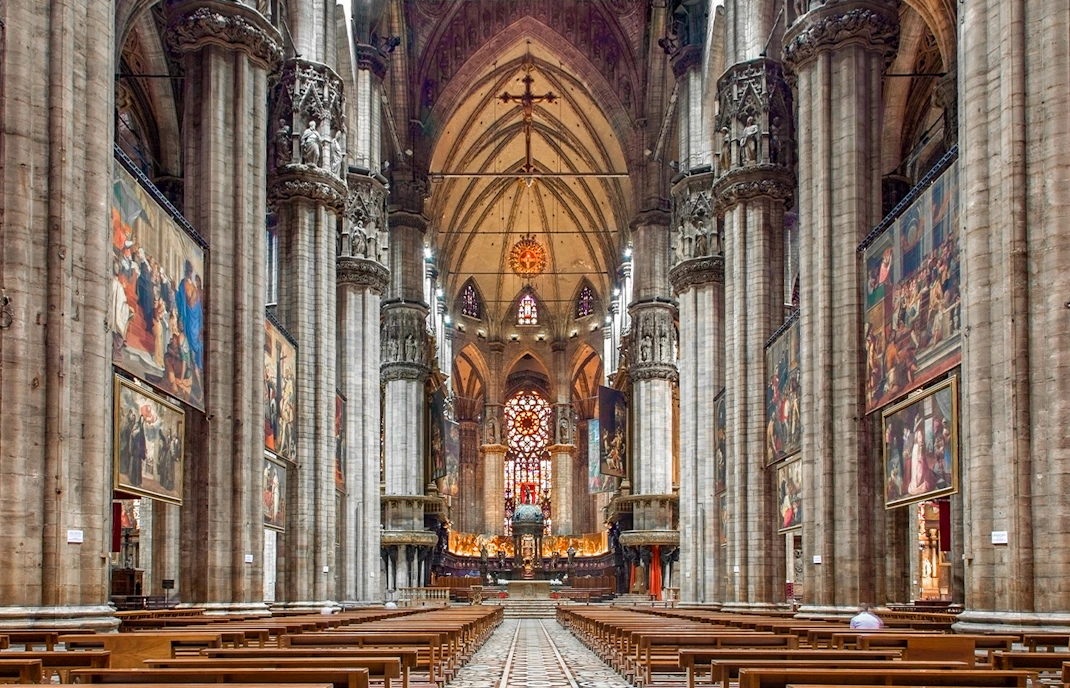
Today, the Duomo remains Milan’s cathedral, a working place of worship, and one of the city’s defining monuments, cared for by the Veneranda Fabbrica del Duomo, founded in 1387. Visitors can move from the nave to the terraces, museum, archaeological area, Church of San Gottardo, and St. Charles Crypt, seeing how each era left a visible mark. Ongoing cleaning, marble replacement, and conservation keep the building readable for future generations. For practical planning, continue to the Duomo Milan About or main visit page.
Frequently asked questions about Duomo Milan’s history
Work began in 1386, but the final ornamental details were only completed in 1965.
It was commissioned to replace older churches on the site and to reflect Milan’s religious importance and political ambition.
The project is closely tied to Gian Galeazzo Visconti, with strong backing from church authorities in late 14th-century Milan.
Design changes, shifting rulers, funding gaps, new artistic tastes, and later restorations stretched the project across 6 centuries.
It is mainly Gothic, but later centuries added Renaissance, Baroque, and Neo-Gothic elements.
Don’t miss the Madonnina, stained-glass windows, St. Bartholomew, the archaeological area, and the terraces.
Yes. World War II bombing affected Milan and led to repairs, though the cathedral survived and remained central to city life.
Yes. By long-standing custom, no Milan building should rise above it, so some modern towers display replica Madonninas.
Combine the cathedral, museum, archaeological area, and terraces. An audio guide or guided tour makes the long timeline much easier to follow.


