Duomo Milan Architecture | Gothic Cathedral Style & Highlights

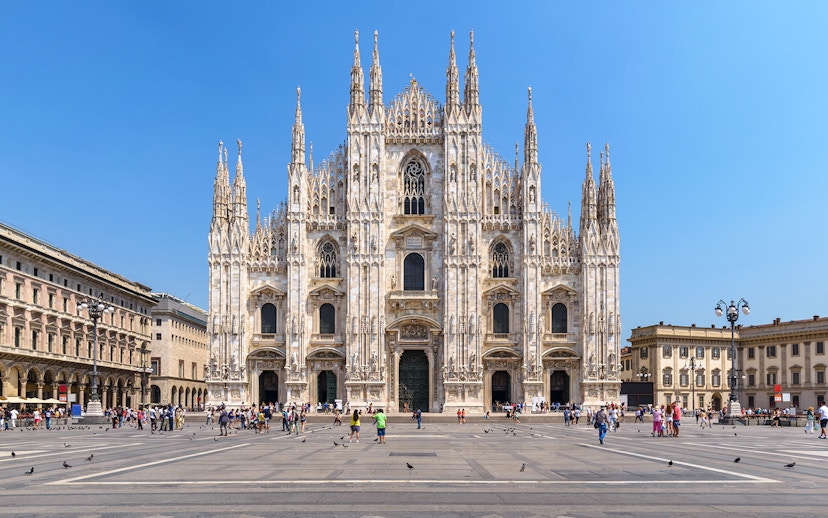
The Duomo di Milano is an Italian Gothic masterpiece and one of the world’s largest cathedrals. Built between 1386 and 1965, it is defined by a forest of ornate spires and a lace-like white marble façade. Inside, five vast aisles rise beneath 45-meter-high vaults supported by 52 massive columns. The cathedral is densely adorned with sculpture, over 3,400 statues line its façades, piers, and niches, while details like the gilded Madonnina atop the main spire, monumental stained-glass windows, and marble mosaics exhibit Gothic drama infused with distinctly Italian artistry.

Architecture of Duomo di Milano | Quick overview

Official name: Metropolitan Cathedral-Basilica of the Nativity of St. Mary
Nature of attraction: Cathedral / Landmark
Dedication: Santa Maria Nascente (Nativity of the Blessed Virgin Mary)
Location: Piazza del Duomo, Milan, Lombardy, Italy, seat of the Archbishop of Milan (Find on maps)
Founded:

  • Groundbreaking: 1386 (under Archbishop Antonio da Saluzzo)
  • Consecrated: 1418
  • Final construction details completed: 1965

Dimensions & scale:

  • Length: ~158.6 m
  • Width: ~92 m
  • Interior layout: 5 naves (aisles)
  • Structural supports: 52 internal columns
  • Capacity: ~40,000 people

Height & vertical elements:

  • Central spire height: ~108 m
  • Total spires/pinnacles: 135
  • Highest point: 108.5 m, crowned by the gilded Madonnina statue

Materials:

  • Brick structural core faced with Candoglia marble (white with pink veins), an exclusive material donated by Duke Galeazzo Visconti

Architectural style:

  • Predominantly Italian Late Gothic
  • Strong French Gothic (Rayonnant) influence
  • Later Renaissance and Neo-Gothic additions, especially visible in the façade and decorative program

Key architects & contributors:

  • Simone da Orsenigo — first chief engineer (1386)
  • Nicolas de Bonaventure and other French masters — introduced Rayonnant Gothic elements (from 1389)
  • Leonardo da Vinci and Donato Bramante — submitted dome proposals (1488, unrealized)
  • Carlo Pellicani — completed the 19th-century façade under Napoleonic direction

Architectural styles & influences on Duomo di Milano

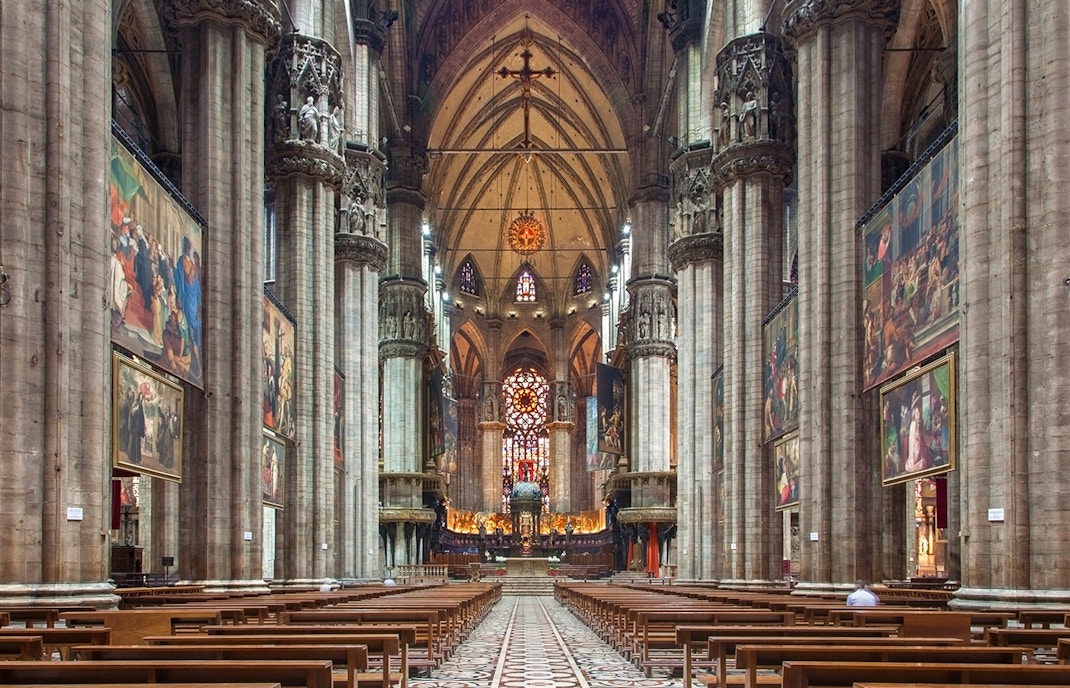
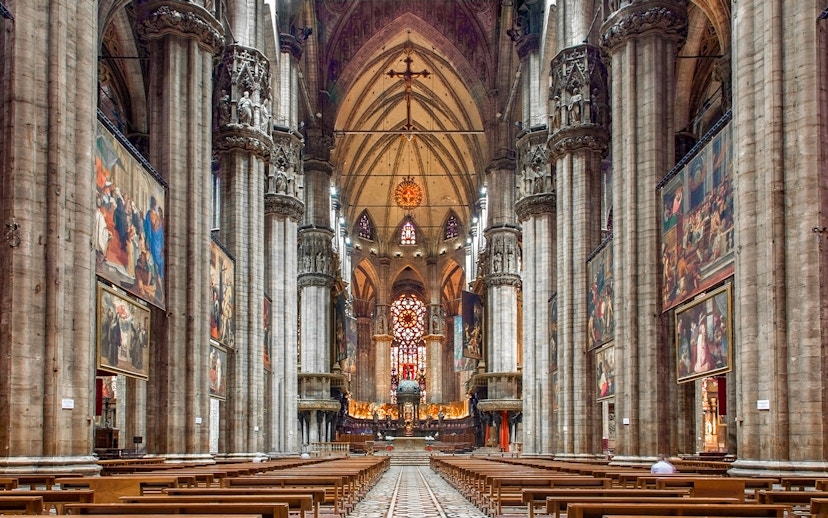
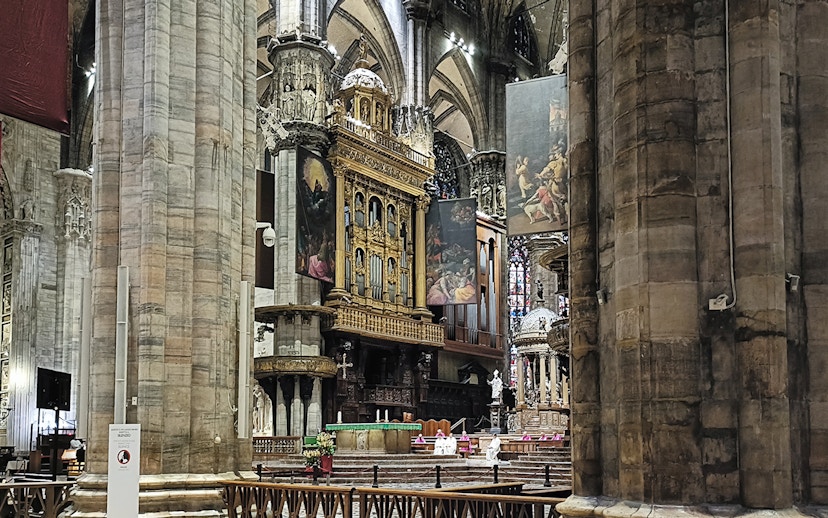
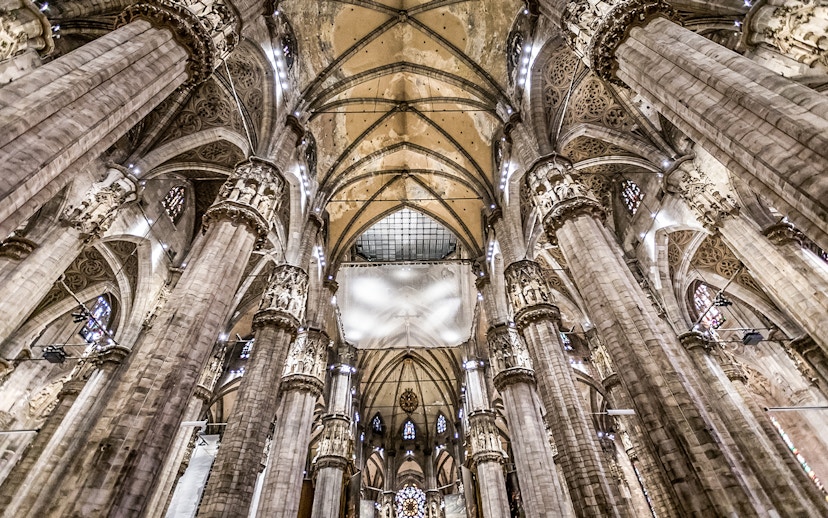
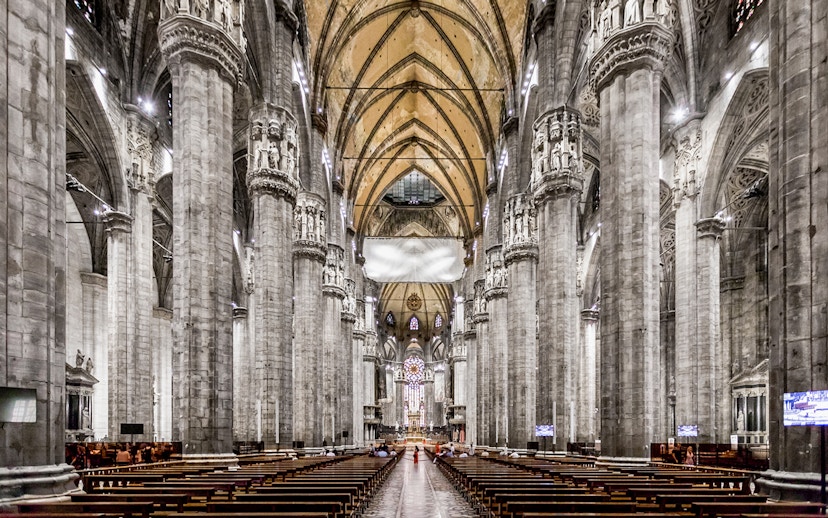
Interior of Duomo Cathedral with towering columns and intricate sculptures, Milan.

The architecture of the Duomo di Milano is fundamentally Gothic, but unlike most Gothic cathedrals in Europe, it reflects a long process of adaptation shaped by Italian taste, politics, and artistic ambition.

Construction began in 1386 using Lombard Gothic, a regional interpretation of Gothic architecture that favored verticality and structural clarity but was traditionally executed in brick. This changed decisively under Duke Gian Galeazzo Visconti, who sought to rival the great cathedrals north of the Alps and invited foreign masters to Milan.
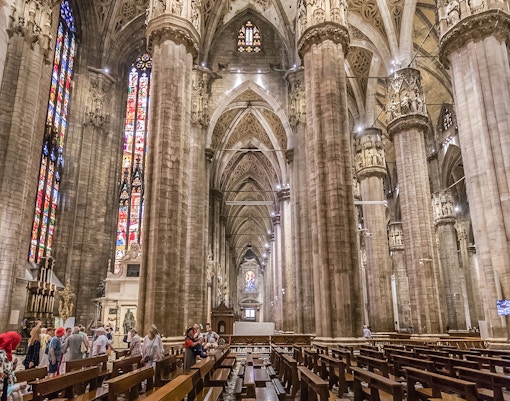
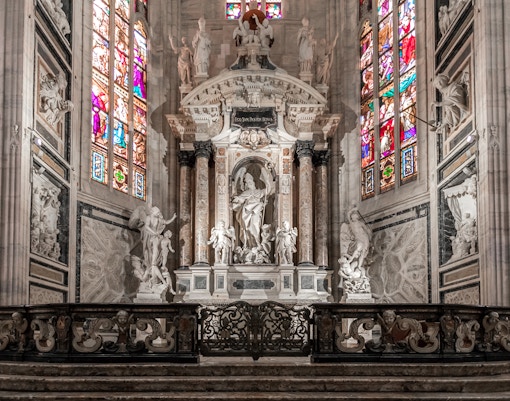
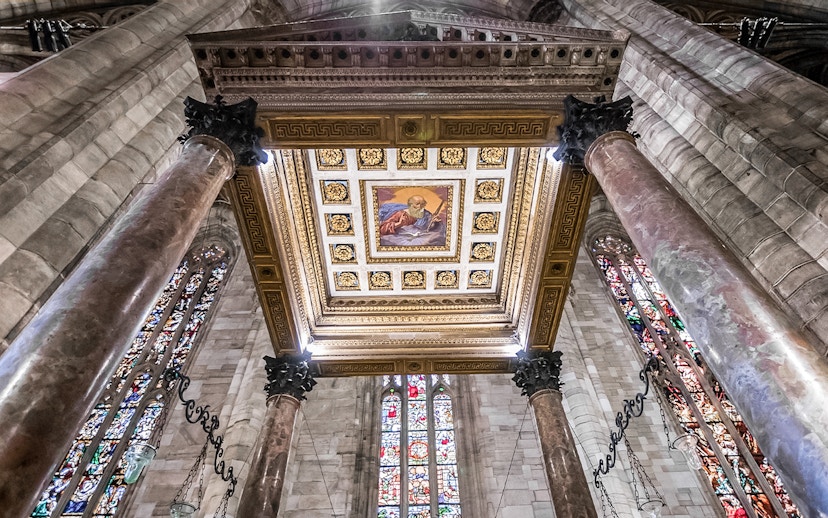
Interior of Milan Duomo with stained glass windows and ornate columns.

A pivotal moment came in 1389, when French engineer Nicolas de Bonaventure introduced Rayonnant Gothic principles, an ornate French Gothic style recognizable by delicate stone tracery, large stained-glass windows, and an emphasis on lightness and vertical rhythm.

These ideas are visible in the Duomo’s soaring proportions, pointed arches, ribbed vaults, and forest of slender spires, visually comparable to cathedrals such as Notre-Dame de Paris or Chartres, though taken to an even more elaborate extreme.

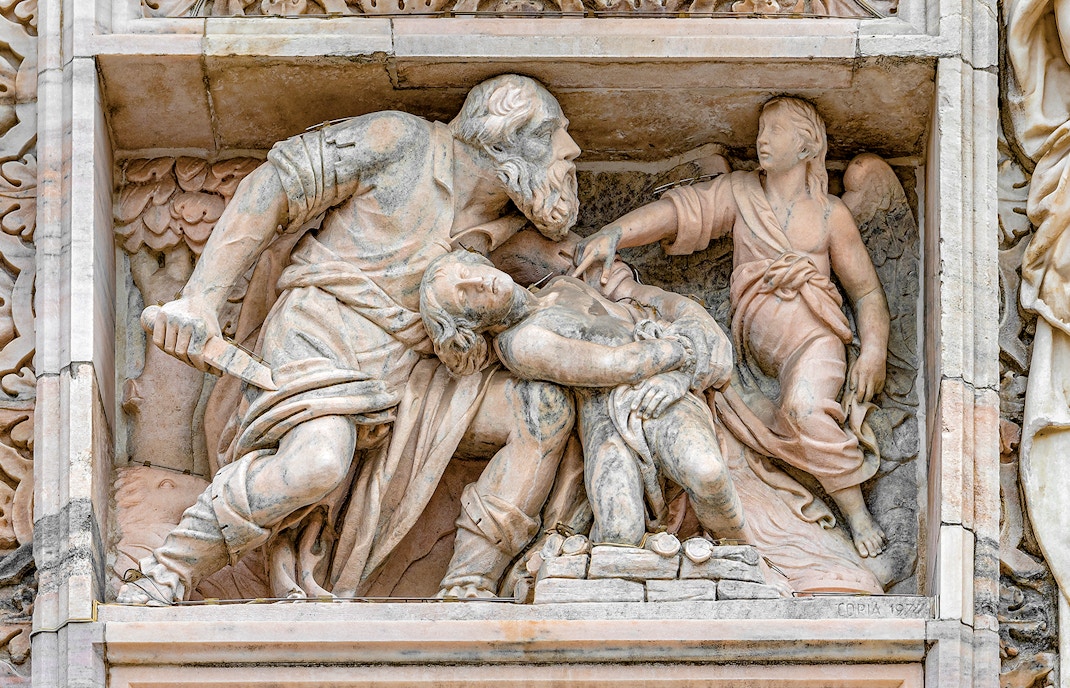
Relief sculpture on Milan Duomo depicting biblical scene with angel and figures.

What truly sets Milan’s cathedral apart is Visconti’s decision to clad the structure in Candoglia marble rather than brick. This luminous white-and-pink stone allowed for extraordinary surface detail, resulting in an exterior saturated with ornament.
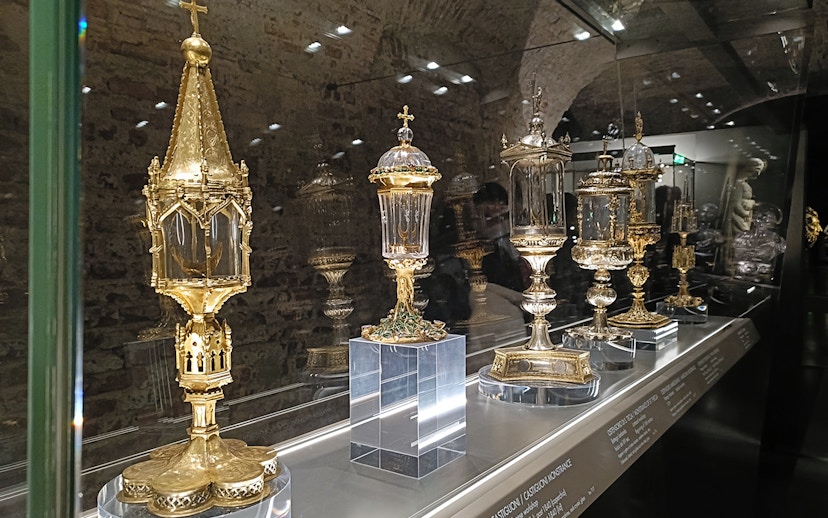
More than 3,400 statues populate façades, pinnacles, and buttresses—saints, prophets, gargoyles, and mythical figures—creating a flamboyant density rarely seen in Northern Gothic churches, which tend to be more restrained.

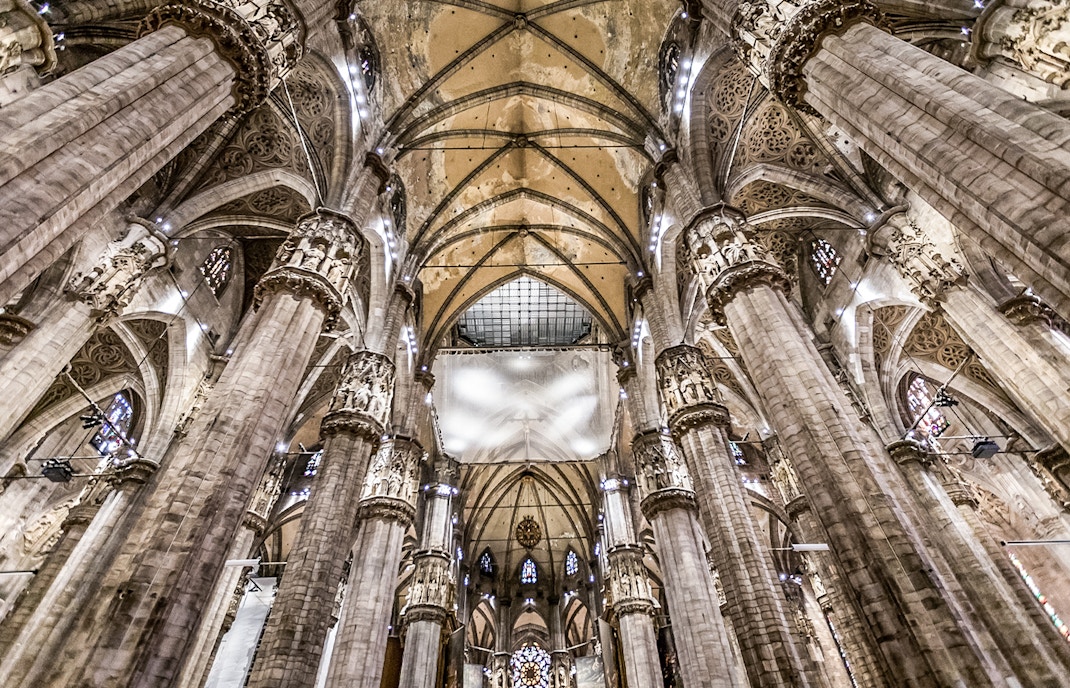
Interiors of Duomo Cathedral in Milan showcasing ornate columns and vaulted ceilings.

Italian influence emerges strongly in later phases. In the 16th century, Archbishop Carlo Borromeo introduced Renaissance and Counter-Reformation elements, particularly in the crypt, presbytery, and side altars. These areas emphasize classical proportion, clarity, and sobriety, reflecting Rome’s influence during the Catholic Reformation.
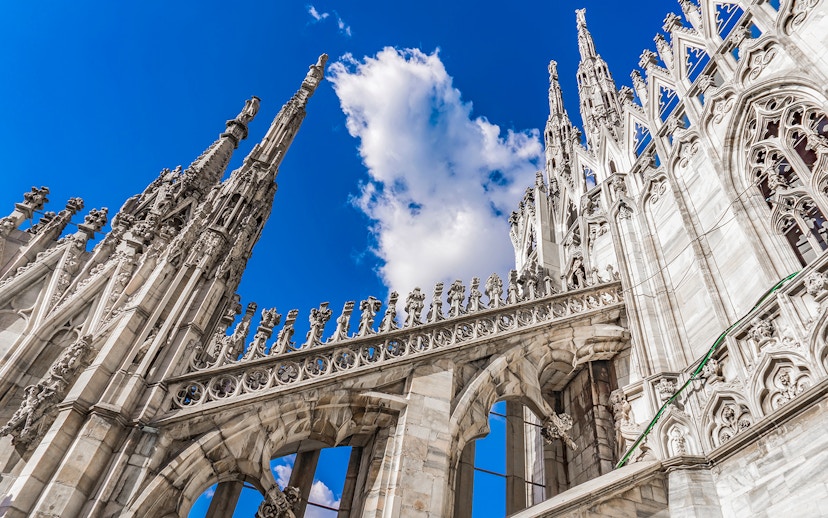
Despite this, the building’s dominant identity remains Gothic: the nave vaults rise to about 45 meters, among the tallest ever completed in a Gothic church.

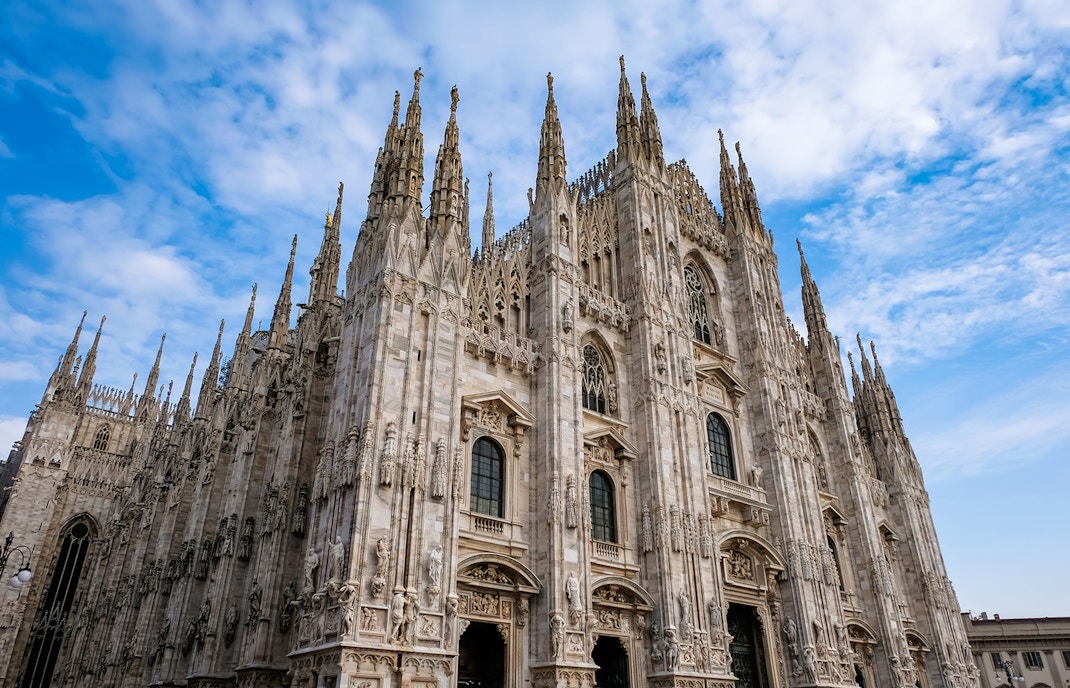
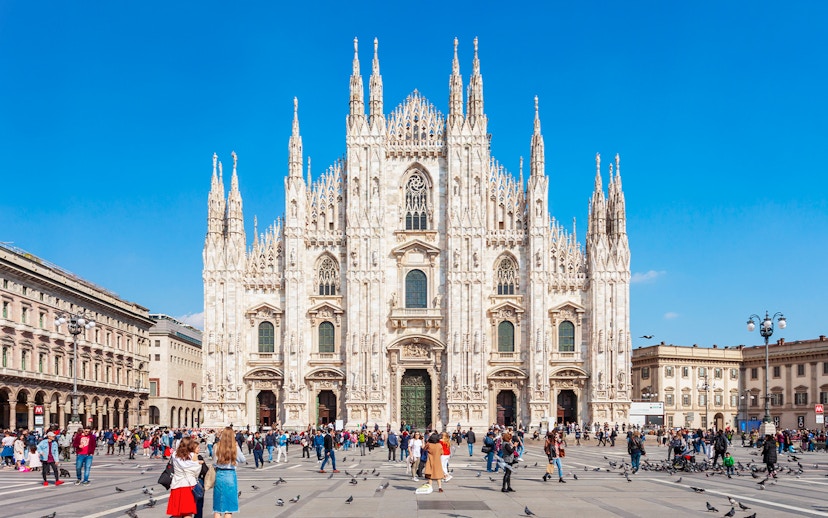
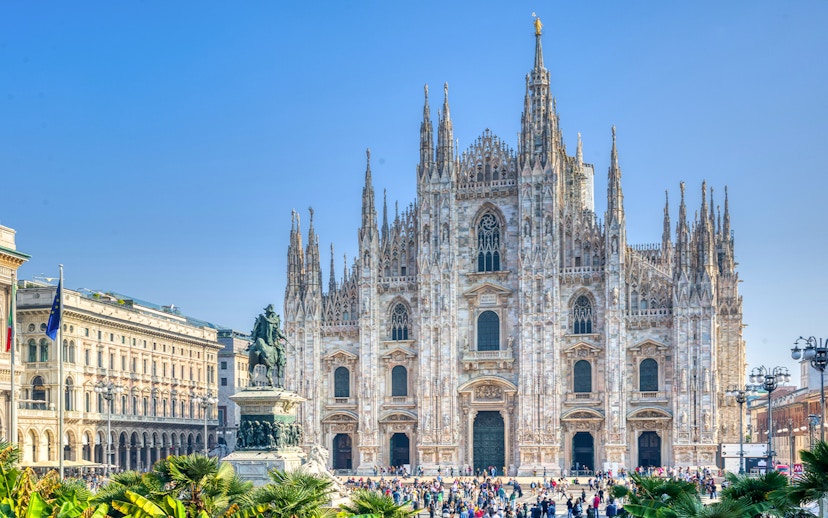
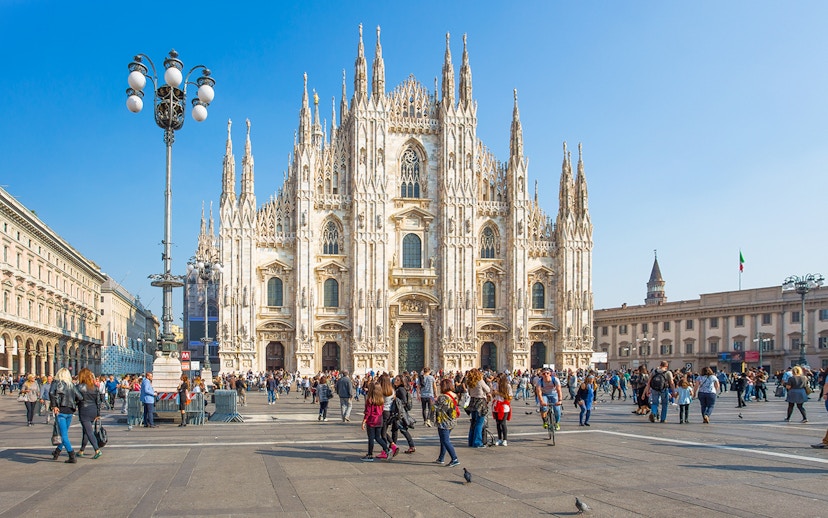
Duomo di Milano facade with spires under blue sky.

The cathedral’s final appearance was shaped in the 19th century, when its façade was completed in a Neo-Gothic style under Napoleonic rule. This phase unified centuries of construction into a coherent—if eclectic—whole.

As critic John Ruskin famously observed, the Duomo “steals from every style,” yet achieves a striking unity. The result is a cathedral that transcends strict stylistic labels: unmistakably Gothic in structure, unmistakably Italian in richness, and utterly unique in execution.

Design highlights & iconic features of Duomo Milan

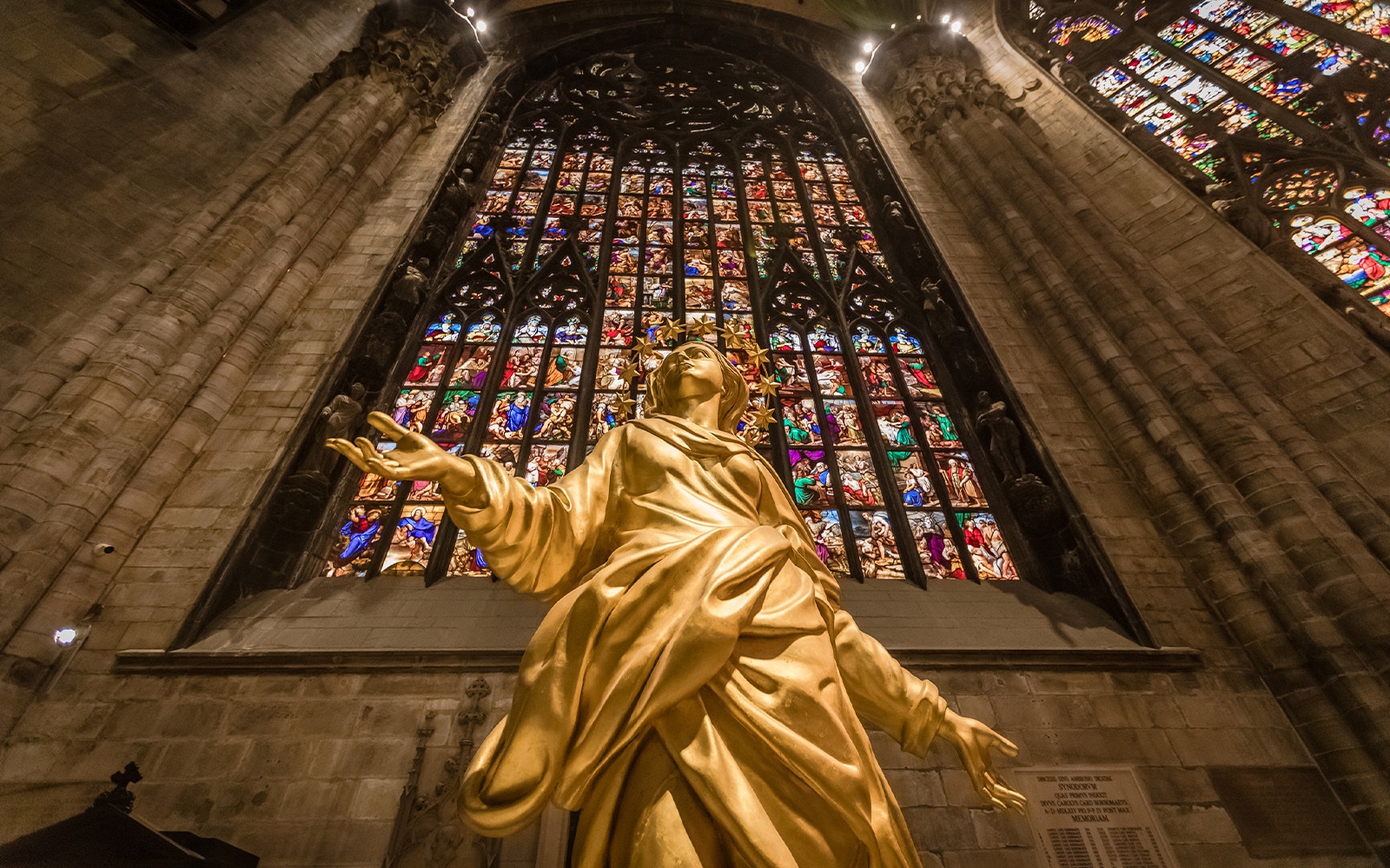
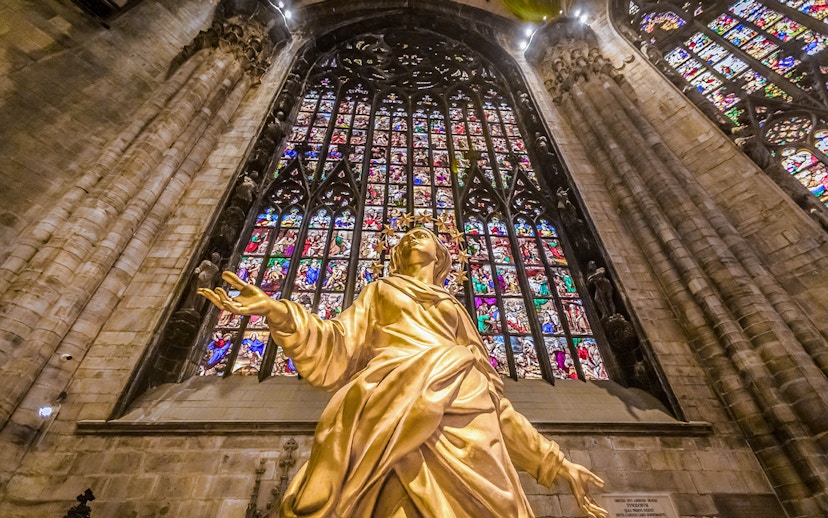
Golden statue of Madonnina inside Milan Cathedral with stained glass windows.

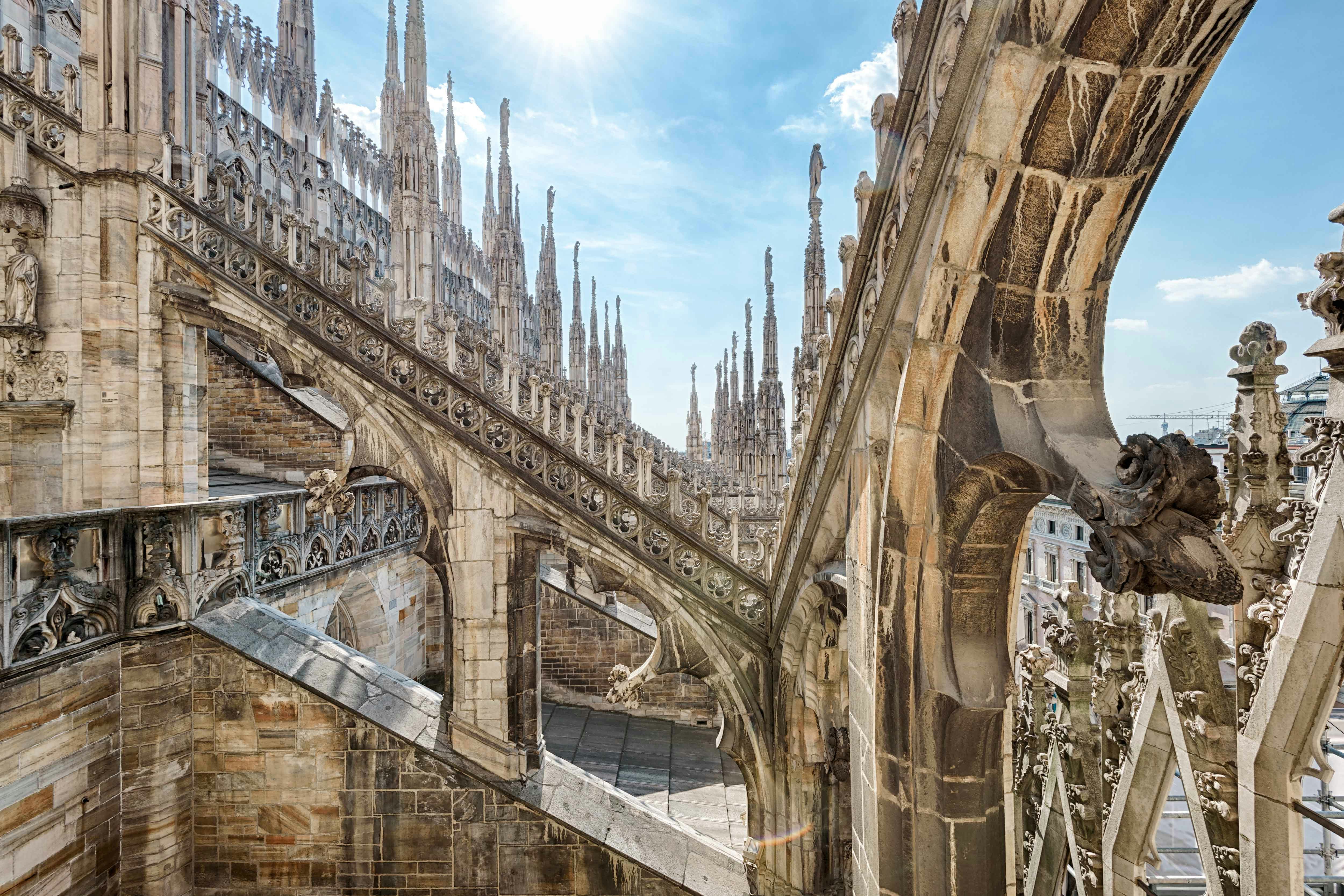
Forest of spires & the Madonnina

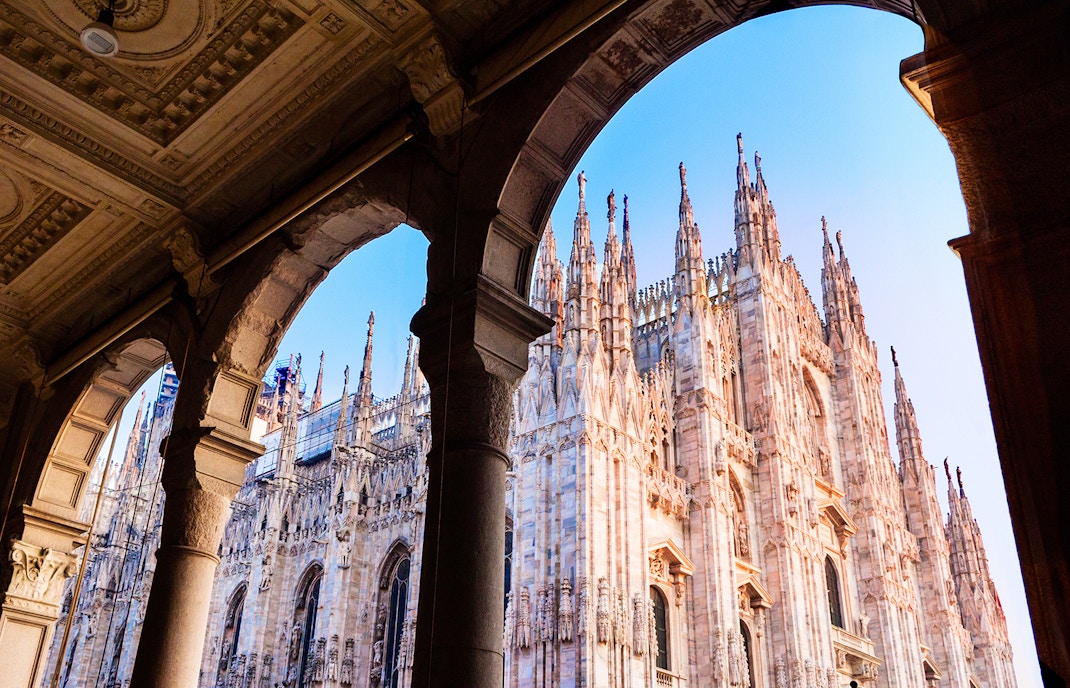
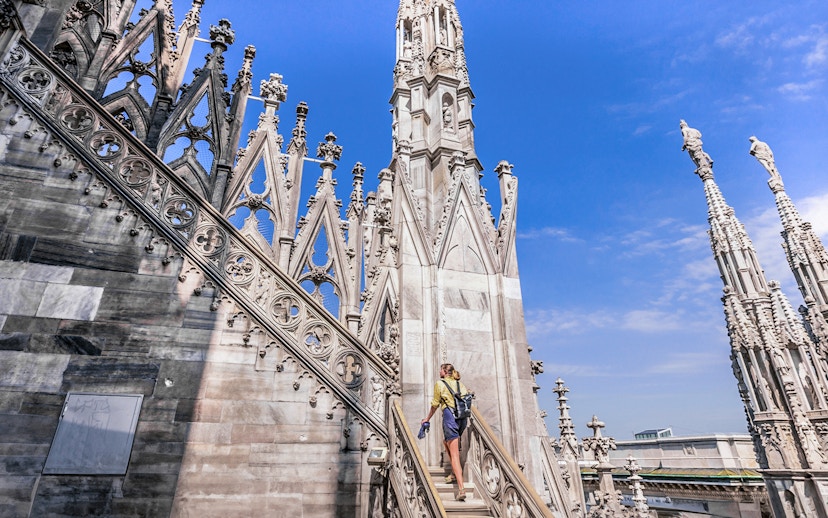
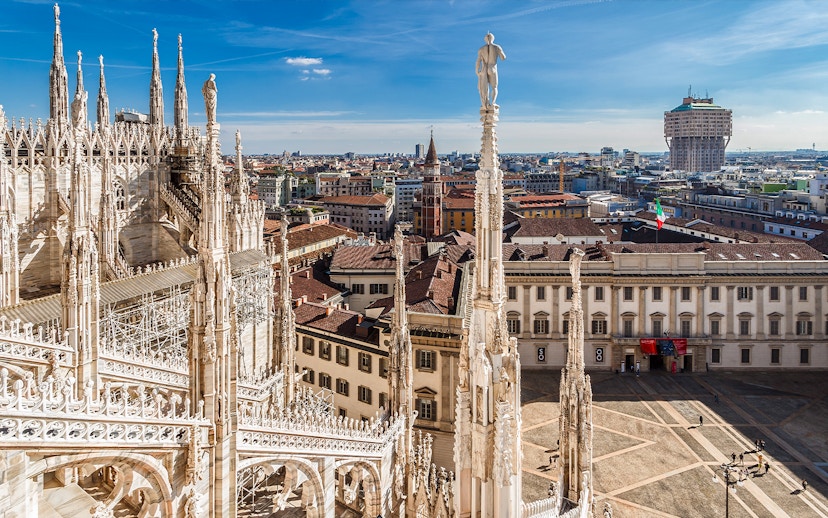
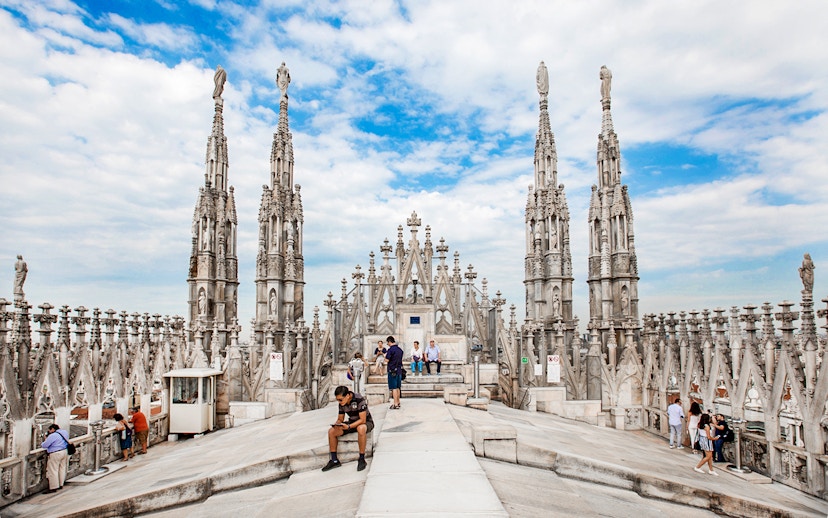
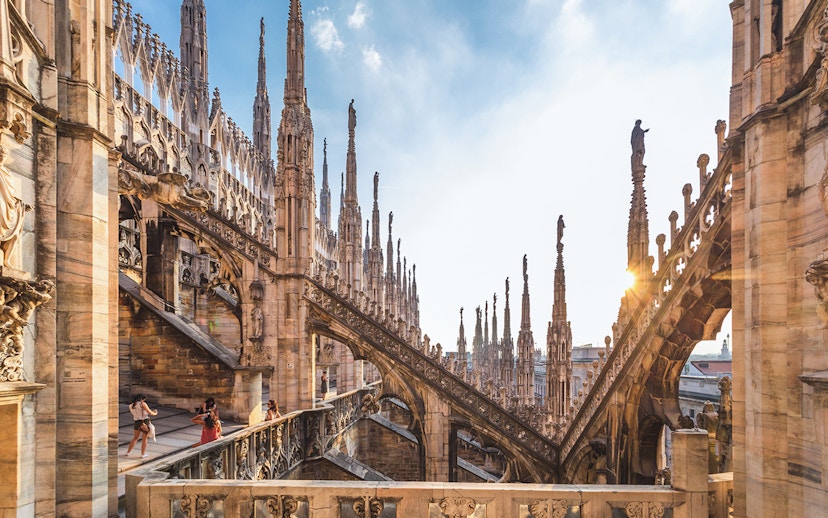
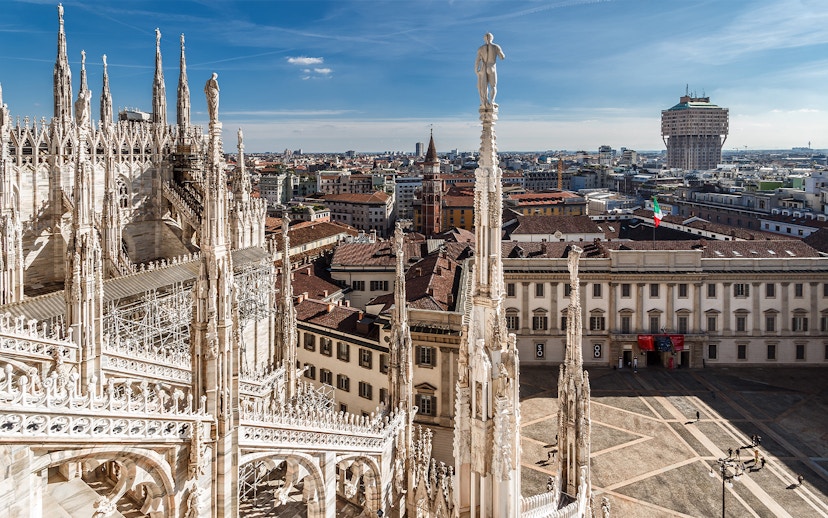
A dramatic skyline of 135 marble spires crowns the cathedral. The tallest supports the gilded Madonnina (1774), Milan’s most beloved symbol, visible from across the city.

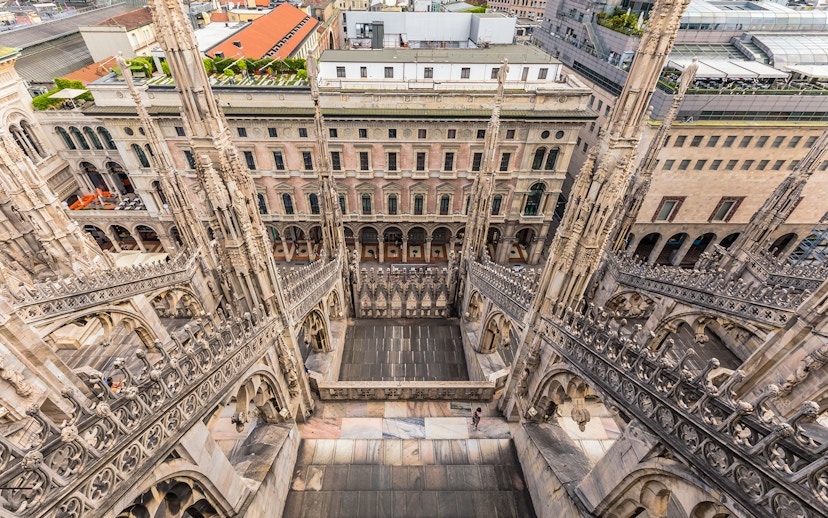
Duomo Milan rooftops with intricate spires and stone carvings under a clear sky.
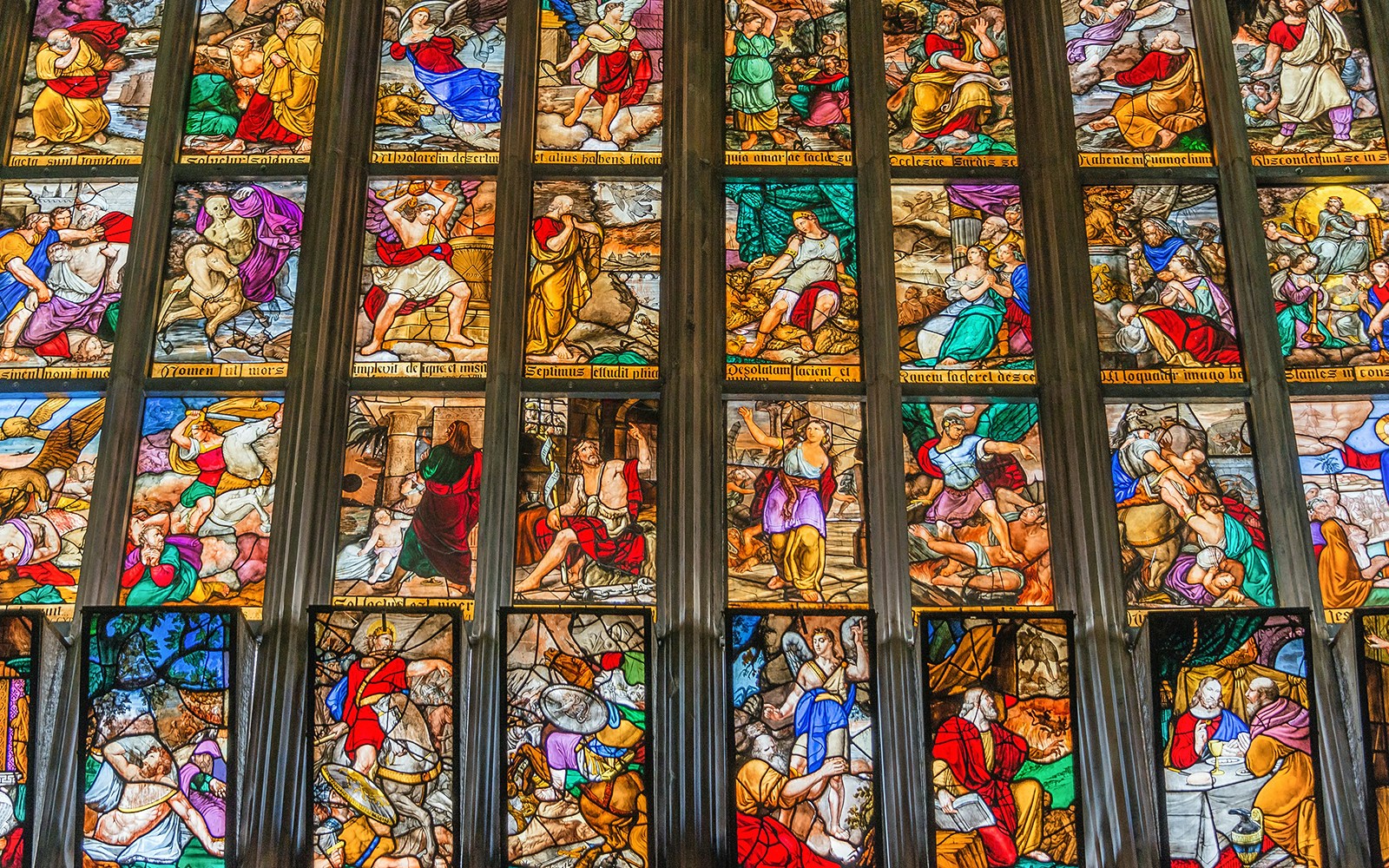
Stained glass windows depicting biblical scenes in Milan Duomo, Italy.
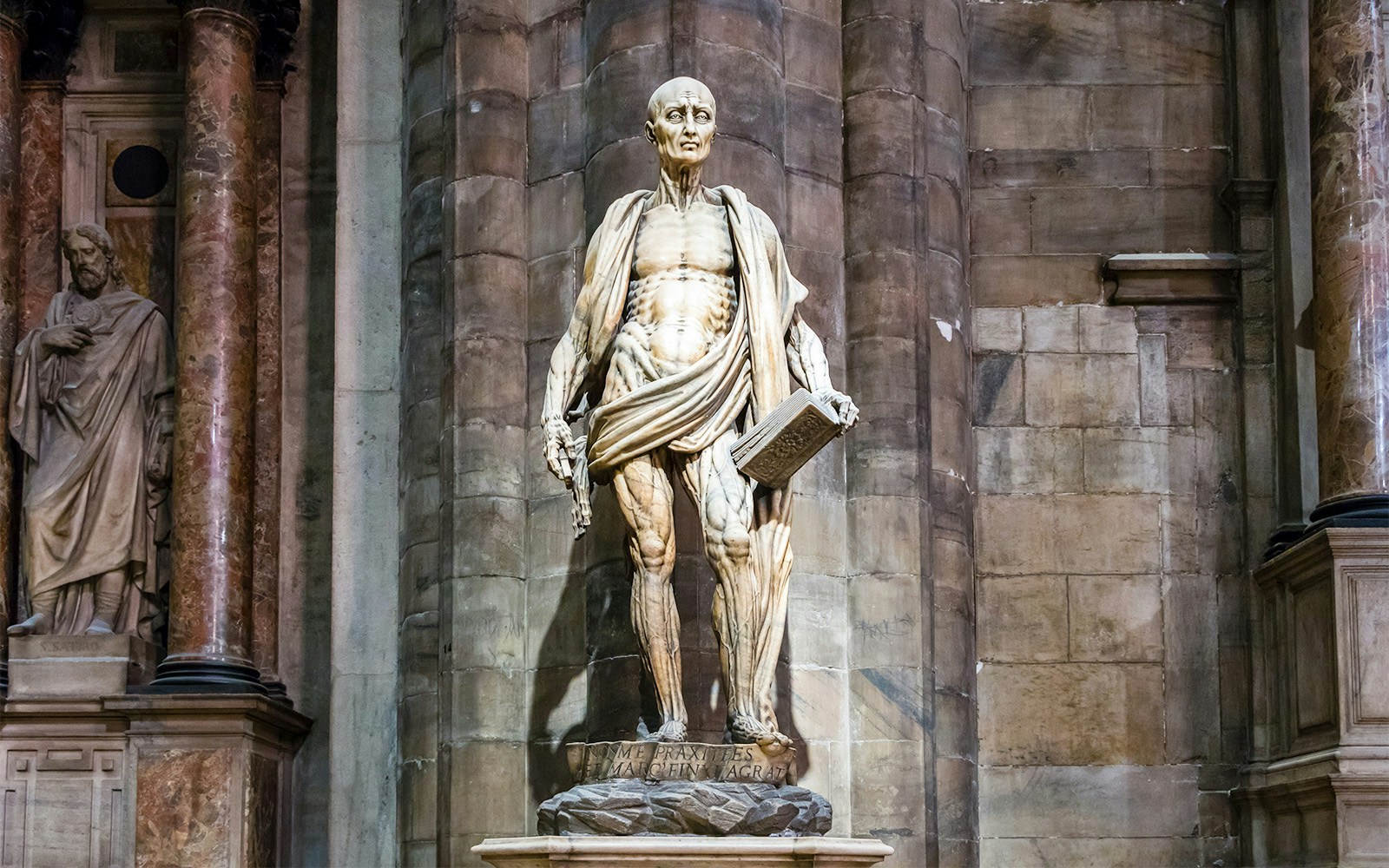
Intricate statue of Saint Bartholomew at Duomo Cathedral, Milan.
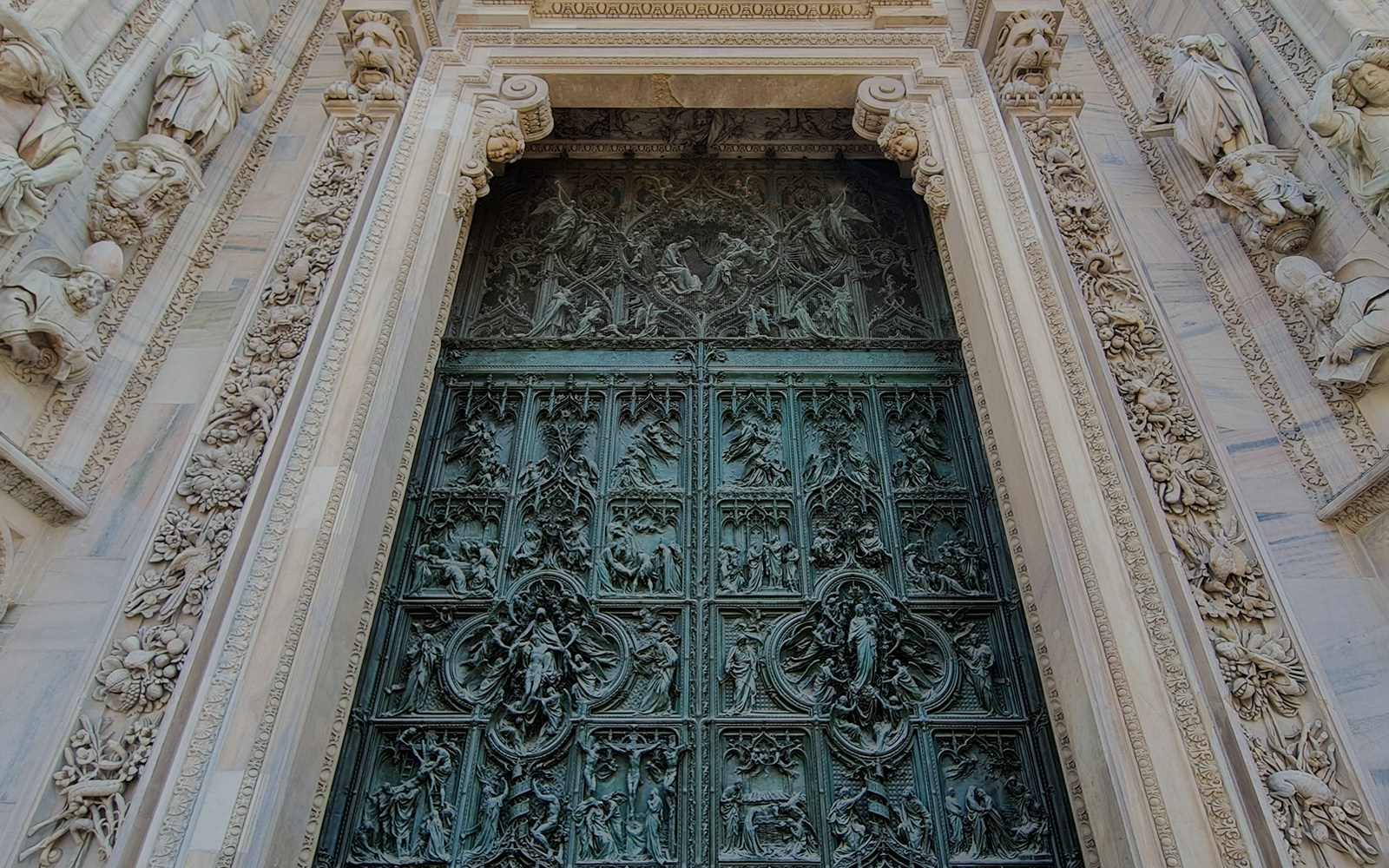
Ornate bronze door of Duomo Cathedral in Milan, featuring detailed religious carvings.

Who designed/built Duomo Milan?

Primary architect: Simone da Orsenigo (1386)

Local master mason Simone da Orsenigo led the initial design and foundation laying in 1386, blending Northern French Gothic with Italian scale for a "church to eclipse all others." His vision emphasized soaring verticality through flying buttresses and a vast marble-clad expanse.

Key patron: Gian Galeazzo Visconti (1386–1402)

Duke Gian Galeazzo Visconti bankrolled the early phases via guild taxes and indulgences, envisioning Milan's Duomo as a symbol of Lombard supremacy rivaling cathedrals abroad. His death slowed but didn't halt the ambitious project.

Later overseers: Filippino degli Organi & Others (1400s–1800s)

Successive architects like Filippino refined the nave and spires; Napoleon "completed" it in 1805. No single genius dominated, guild committees and evolving masters shaped its 600-year evolution.

History of Duomo Milan’s architecture | Stages of construction

Gothic Foundations (1386–1402)

Construction kicked off in 1386 under Archbishop Antonio da Saluzzo and the powerful Sforza-Visconti patronage, funded by Milan’s trade guilds and indulgences. Simone da Orsenigo, a local architect, laid the massive foundation stone, envisioning a colossal Gothic cathedral to rival Europe’s greatest. The initial octagonal lantern design for the apse drew from Northern French Gothic models, with white Candoglia marble quarried exclusively for the project, a royal decree ensured its purity. By 1402, the first bays of the nave rose, but progress stalled amid plagues and funding woes.

Nave and Transept Expansion (1402–1510)

Gian Galeazzo Visconti’s death slowed momentum, yet Filippino degli Organi and others pushed forward, completing the nave and transepts by the early 1400s. Innovations like external flying buttresses, uncommon in Italian Gothic, supported the vast interior. Lesser-known: guild rivalries led to decorative competitions, with bakers funding bread-themed corbels. By 1510, under French occupation, the structure stood at two-thirds height, showcasing intricate pinnacles and a burgeoning forest of 135 spires.

Renaissance Interventions and Façade (1515–1813)

Napoleon Bonaparte declared it complete in 1805 (despite unfinished roofs), adding the gilded Madonnina statue in 1774 as a symbolic capstone. Earlier, Renaissance architects like Tibaldi modified the tribunes for stability. The asymmetrical façade, a patchwork of Baroque and Neoclassical elements, dragged until 1813 under Carlo Amati.

Modern restorations and innovations (19th Century–Present)

Post-1800s cleanings revealed original marble sheen; 20th-century engineers reinforced foundations against subsidence using steel tie-rods. WWII bombs damaged spires, restored by 1950s. Today, laser scanning drives ongoing work on the 3,400+ statues.

The exterior of Duomo Milan

Tourists on Milan Hop-On Hop-Off bus tour with Milan Duomo in view.

Towering Gothic Silhouette and Scale

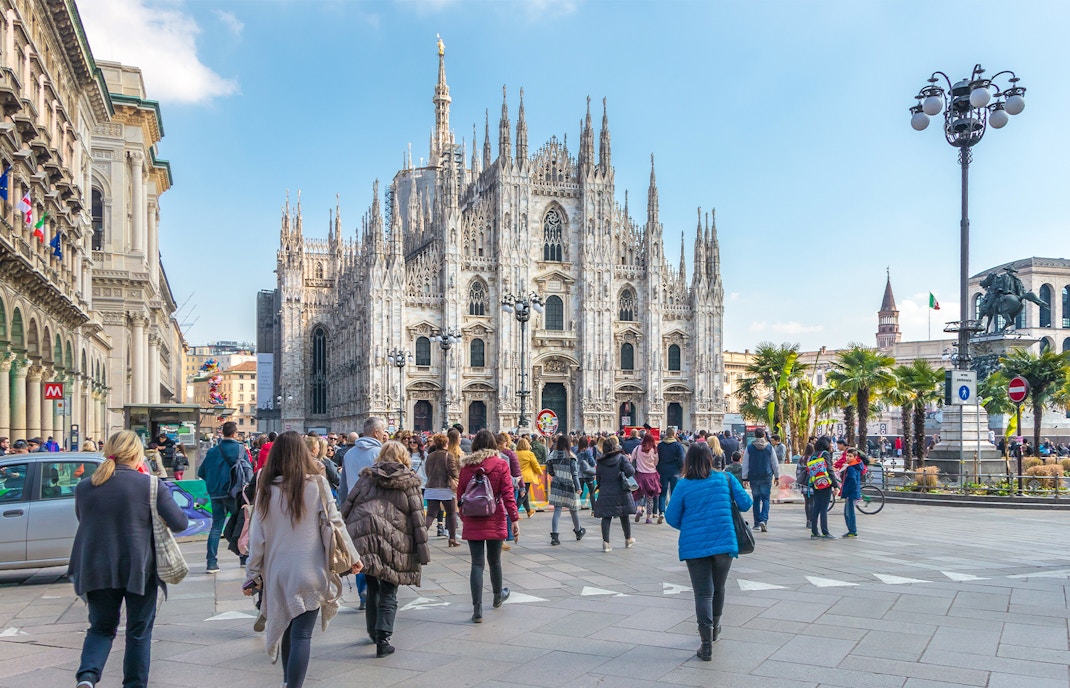
From afar, the Duomo's jagged skyline dominates Milan's Piazza del Duomo, rising 108 meters at its highest spire crowned by the gilded Madonnina statue (1774). This forest of 135 pinnacles and 3,400+ statues creates a fairy-tale Gothic spectacle, visible for miles. Its cruciform layout spans 158 meters long, with flying buttresses propping the vast white marble walls, sourced exclusively from Candoglia quarries since 1387.

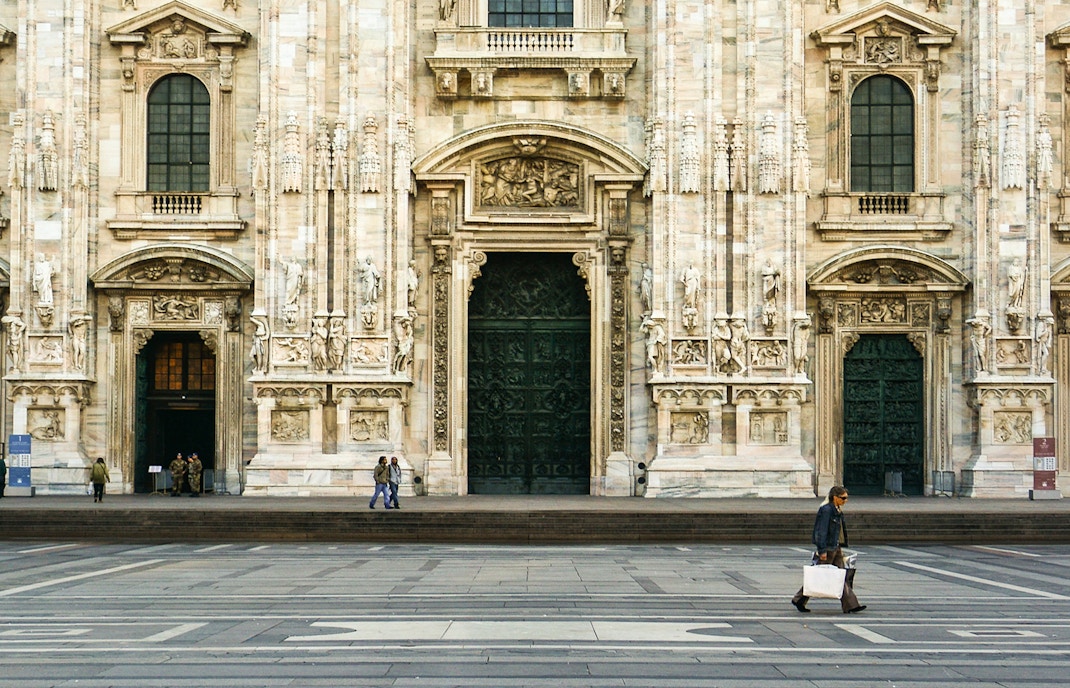
Main entrances of the Duomo in Milan with ornate architectural details.

Ornate façade and entrances

Up close, the asymmetrical western façade blends Gothic lacework with Baroque additions: five bronze doors (added 1906) depict biblical scenes, flanked by 52 Corinthian columns. Enter via the central portal under a tympanum of the Last Judgment. Symmetry reigns in the structured bays, but Renaissance tweaks by Pellegrino Tibaldi added robust pilasters for stability post-settling cracks.

Milan Duomo Cathedral facade with tourists on Best of Milan Duomo Cathedral & Da Vinci's 'Last Supper' Tour.

Marble marvels and structural innovations

Candoglia marble gleams pinkish-white, carved into 2,000+ saints, apostles, and quirky figures like a 14th-century condottiero on a buttress. Arches and tracery form a "stone embroidery" screen, while terracotta reinforcements hide behind. WWII bombs scarred spires (restored 1940s–60s); modern laser cleaning (2010s) revived its luster.

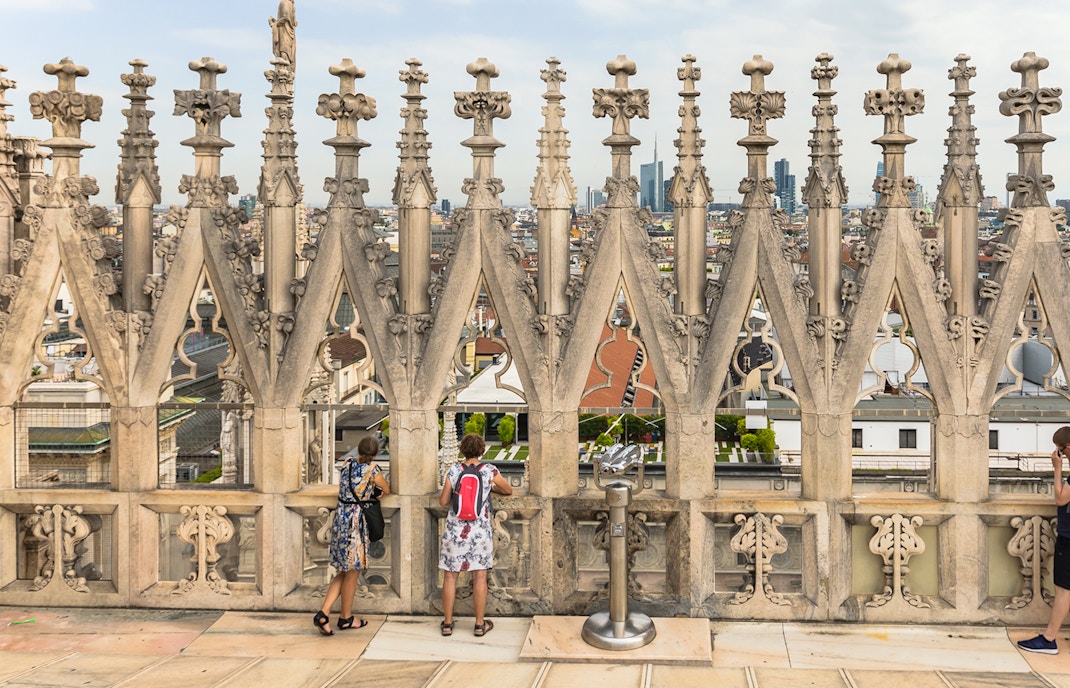
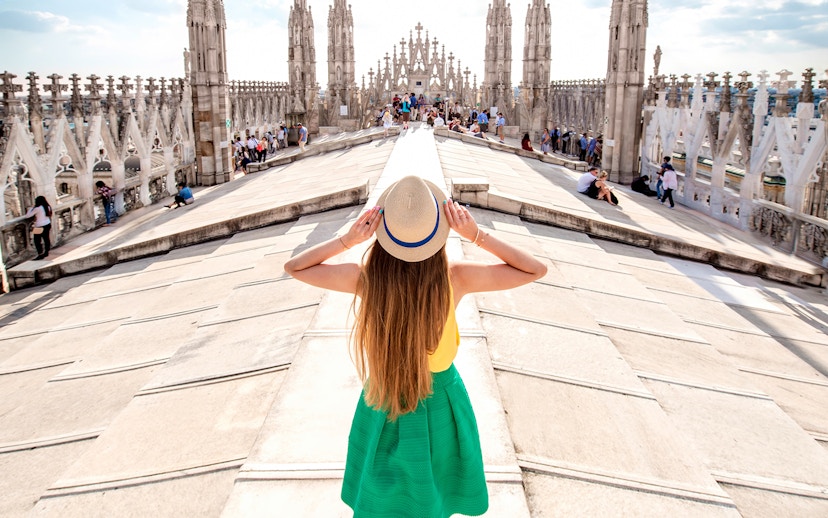
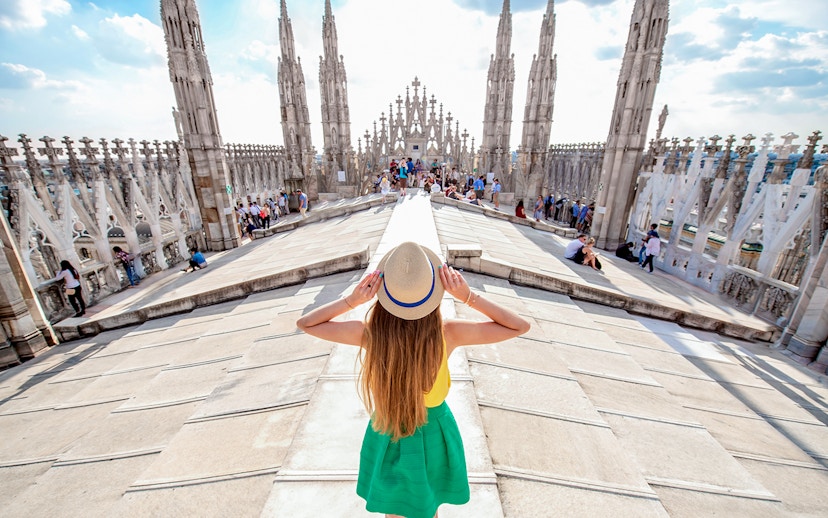
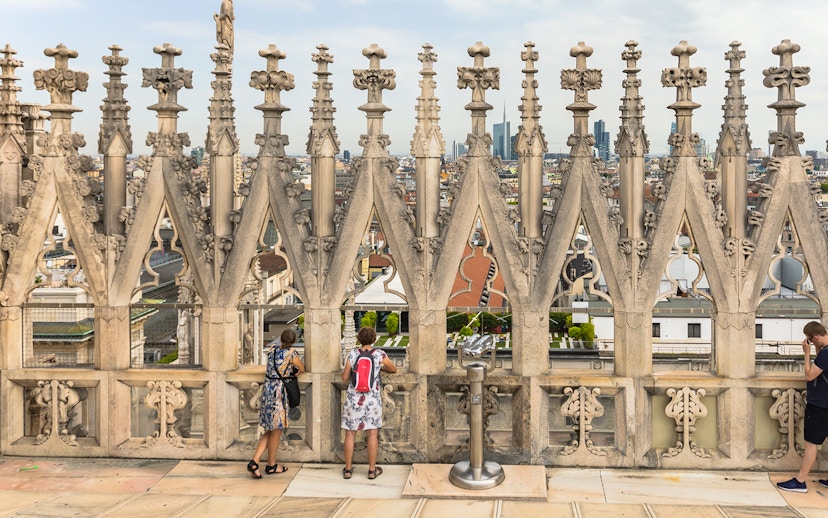
Visitors on the terraces of Milan Cathedral with city view through ornate stonework.

Visual journey: Distance to detail

Distant views stun with ethereal height; approach reveals intricate narratives—spot animals, self-portraits of builders. Climb rooftop terraces for panoramic intimacy amid the spires.

The Interior of Duomo Milan

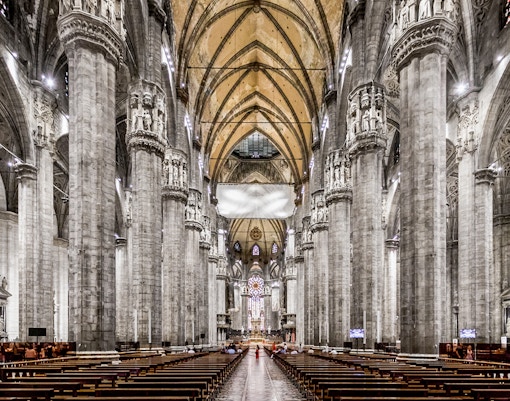
Duomo Cathedral Milan interior with ornate columns and detailed ceiling.

Central Nave

The vast central nave, twice the width of side aisles at 45 meters high, follows Gothic basilica style with a Latin cross layout for processions and masses. Supported by towering brick pillars clad in Candoglia marble, it symbolizes heavenly ascent while distributing weight to groin vaults. Its grandeur accommodates 40,000, fostering awe during services.

Duomo Cathedral interior in Milan with ornate columns and detailed ceiling.

52 Columns and Pillars

These colossal Gothic pillars, each symbolizing a week of the year, bear intricate capitals with layered statues of saints and apostles for structural fusion and narrative depth. Brick cores with marble veneer ensure stability amid the vast span, blending utility with symbolism of faith's pillars.​

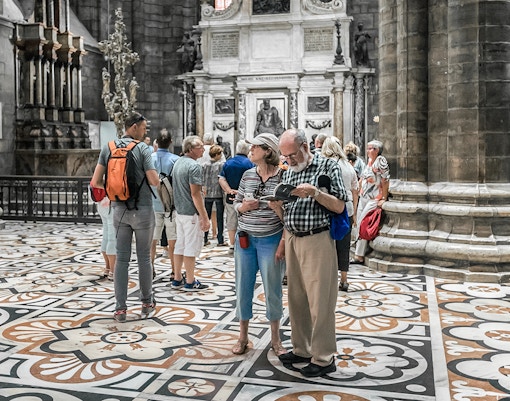
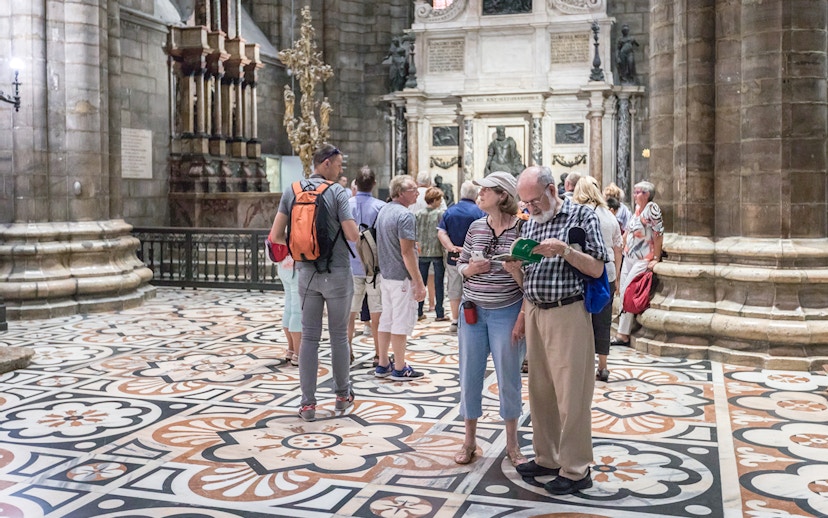
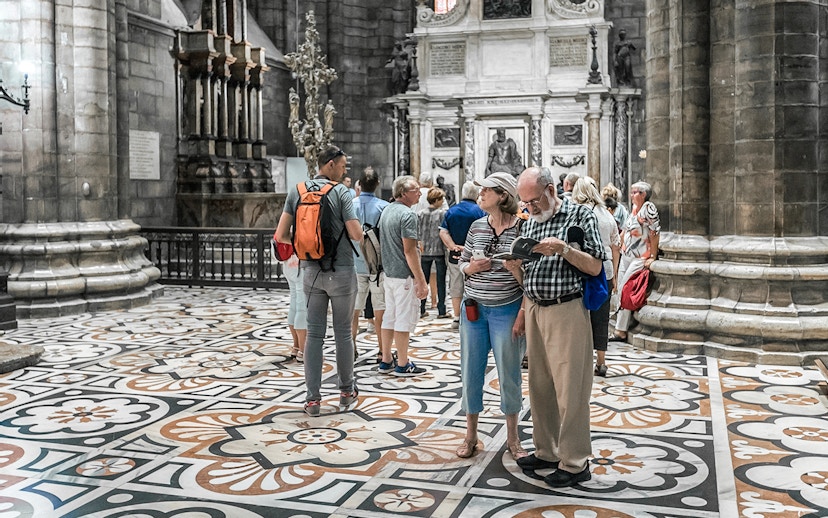
Tourists exploring the interior of Duomo Cathedral, Milan.

Marble Floor

Renaissance-era inlays of Candoglia, red Arzo, and black Varenna marble create optical illusions of depth and motion underfoot. Laid from 1585 for durability and beauty, patterns evoke sacred geometry, guiding pilgrims visually toward the altar.

Duomo Cathedral Milan interior with ornate columns, detailed ceiling, and stained glass windows.

Transept and Chapels

The transept's three aisles host Baroque altars and the 5-meter Trivulzio Candelabrum, carved with biblical vices and virtues for liturgical drama. Side chapels serve devotion and house relics, their arches enhancing acoustic resonance during chants.

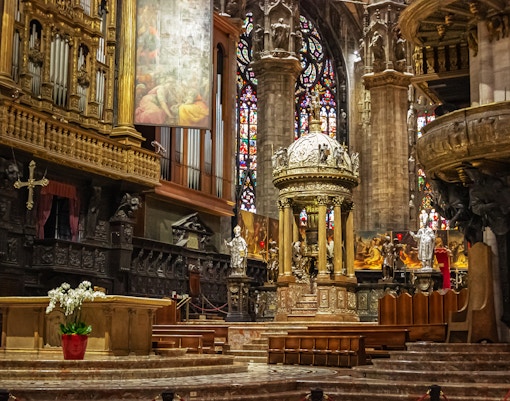
Presbytery and altar inside Duomo di Milano with ornate carvings and stained glass windows.

Stained Glass Windows and High Altar

World-class 15th-century Gothic windows flood color across the space, narrating scripture for the illiterate masses. The wooden choir and ciborium-shrouded high altar, with the Holy Nail relic, anchor sacraments amid Renaissance cupola by Bramante.

Frequently asked questions about Duomo Milan’s architecture

Why is Duomo Milan’s architecture famous?

Duomo Milan's architecture stands out for its rare Italian Gothic style, featuring 135 spires, over 3,400 statues, and Candoglia marble facade—built over 600 years, blending international influences into a "stone embroidery" masterpiece.

What Gothic style is the Duomo?

It's primarily Rayonnant and Flamboyant Gothic, with Perpendicular elements, imported from France and Germany, uncommon in Italy, chosen by patrons to symbolize Milan's power.

Who designed the Duomo Milan?

No single designer; Simone da Orsenigo started it, with guild overseers like Filippino degli Organi and later Renaissance tweaks by Tibaldi. Committees managed its evolution.

What inspired the Duomo’s design?

Inspired by French Gothic cathedrals like Chartres, per Gian Galeazzo Visconti's vision to rival Northern Europe, using flying buttresses and tracery for unprecedented scale.

Did Leonardo da Vinci design part of it?

Leonardo competed in 1487 for the octagonal dome (tiburio), proposing Brunelleschi-inspired double-shell ideas, but his radical plan wasn't selected

More reads

About

Rooftop

Plan your visit